


The IB Diploma Programme is widely regarded as one of the most demanding—and most future-ready—pre-university programmes in the world. Its focus on inquiry, sparking curiosity and lifelong learning, and the development of transferable skills makes it uniquely aligned with the needs of the fast-evolving world.
However, success in the IB Diploma rarely happens by chance. Preparation, mindset, and strategic approaches matter even before the first day of DP1.
Many factors can predict a smoother IB Diploma journey, such as a solid foundation in the Middle Years Programme (or equivalent), strong English proficiency, and well-developed cognitive skills, to name a few.
However, what often determines whether students thrive at the IB Diploma stage is more about what they strategically do – even in the absence of some of the predicters as explained above.
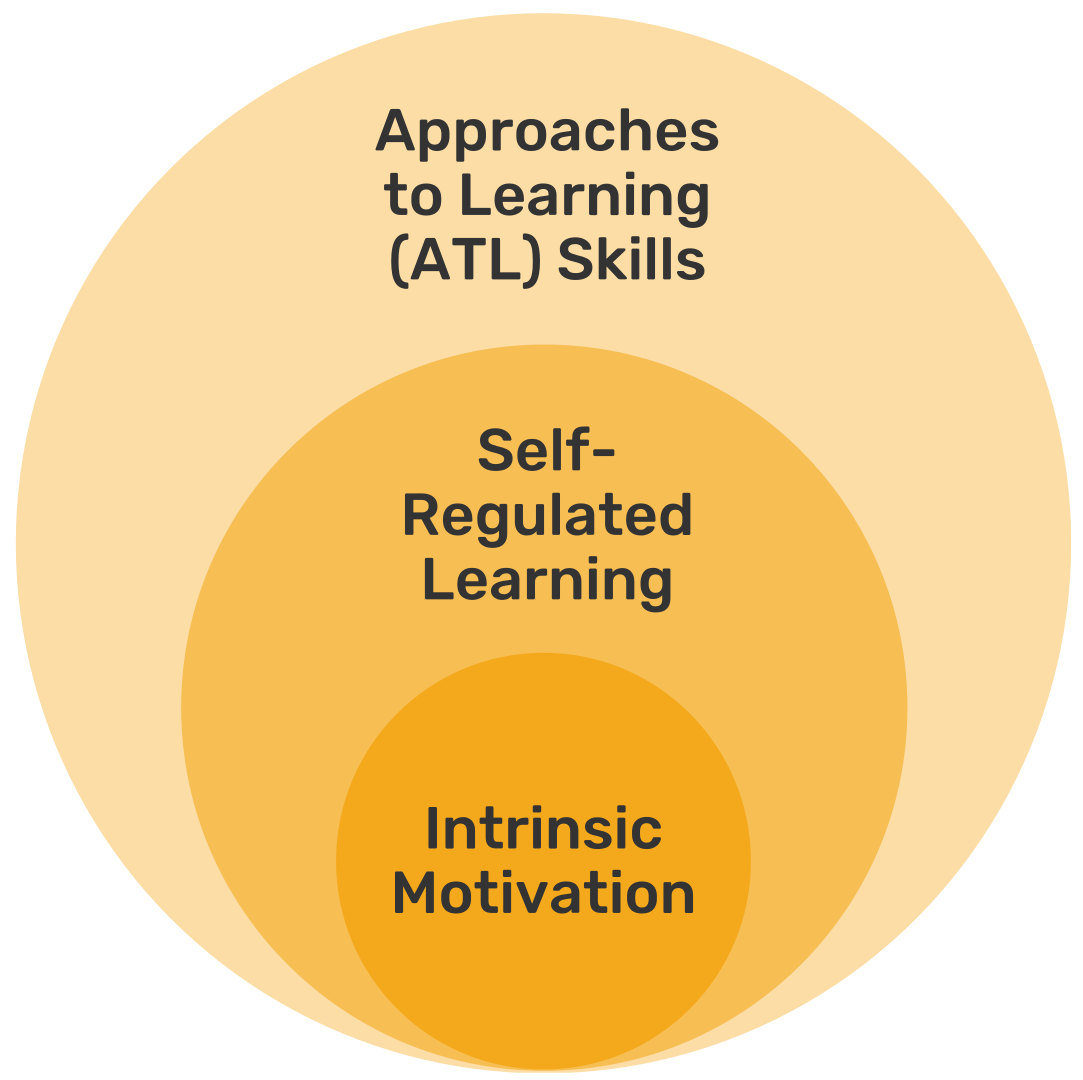
Three central pillars—Approaches to Learning (ATL) skills, Self-Regulated Learning, and Intrinsic motivation—form the backbone of success and are largely within a student’s control.
Let’s look closer to each one and see what is within the students’ grasp.
IB Approaches to Learning skills – being 21st-century ready
ATL skills are at the heart of the IB experience – these include communication, social, research, thinking, and self-management skills.
Students who practice ATLs early gain a clearer sense of how to learn, not just what to learn. At the IB Diploma Programme level, some of the most effective ATL catalysers of success, which I present every year to students and parents are: excellent level of organisational skills and time-management (all part of the self-management umbrella), strong emphasis on:
- Approaches to Learning (ATL) Skills;
- Self-Regulated Learning;
- Intrinsic Motivation;
- Avid note-taking every lesson (they are part of organisation skills within self-management), and having a solution-driven mindset (part of the self-management reflection and affective skills).
I consider these as basic parts of the mechanisms that allow a student to turn effort into achievement.
Self-Regulated Learning: shaping your own journey
While ATLs give students the tools, self-regulation regulates how and when those tools are used. Self-regulation is the ability to plan, monitor, and reflect on one’s own thoughts, behaviour and emotions. This is what will transform the perspective of the IB is something that “happens to you” into something that is “shaped by you”.
A key theory linked to self-regulation is the attribution theory by Heider & Weiner, which focuses on the reasons people use to explain their successes and failures.
Successful IB Diploma students tend to attribute their performance and success to factors within their control such as effort and strategies used rather than to luck or external circumstances they do not control.
How can students then practice self-regulation in the IB Diploma Programme?
- Plan ahead, practice regularly and anticipate challenges such as particular subjects, topics, tests, assignments and very busy weeks.
- Use feedback as a tool for continuous improvement and not static comments that you can forget and move on. I once heard a high-achieving IB Diploma student summarise this mindset perfectly: “Please keep giving me feedback until I reach the highest grade.”
- Actively searching for solutions rather than waiting for conditions to become easier. This includes (not limited to) getting additional support and expertise from the wealth of support the school and families provide, regular communication with teachers, and adjusting less effective planning, strategies and study approaches.
- Managing distractions and maintaining productive routines at school and home.
Motivation: driving engagement, resilience and persistence
While motivation drives effort, effort will drive success. When IB Diploma students start to experience success and a feeling of competence, it builds on itself, gathering momentum just like a snowball rolling downhill. In other words, successful students become even more motivated with time.
Motivation does not happen by chance or come with genetics alone. One of the most influential frameworks for understanding how a student gets motivated is the Self-Determination Theory developed by Richard Ryan and Edward Deci, which highlights three essential psychological needs:
- Autonomy – making one’s own decisions about what we do and being in control of ourselves and our behaviours (e.g. students who study because they choose to, not because they are told to)
- Competence – feeling able to accomplish a task (e.g. completing a cross-country run without having to stop for a rest)
- Relatedness – the feeling of a shared experience with others, of belonging to and being accepted by a group (e.g. belonging to a community such as school, classmates, clubs, study groups)

How can you build motivation looking at the three different central tenets?
- Build relatedness – get involved in the community, connect with others (teachers, staff, peers and the wider community), be genuine and show your true charisma and you will find your niche – you don’t need to please everyone.
- Build competence – all the suggestions given above about the ATL skills and self-regulation are paramount here. This way you are not just spending some time at school – you are raising significantly the number of key take-aways which will significantly boost the quality of study time at home.
- Build autonomy – set personal goals, choose well when to study, rest and have fun and take full responsibility for your learning. Looking at university and future career options and requirements is another great strategy to give you long-lasting goals.
Final Thoughts
Mastering the IB Diploma is not about perfection, nor is it reserved only for those students who begin this journey with every advantage. It is about taking full ownership of the learning process.
The text above shows you some ways in which you can move from “fixed” to a “growth” mindset, from “what” to “why”, from “static” to “transformational” and “adaptive” and using the IB Diploma as a springboard for future success.